
Closing the Leadership Gap
Leadership Circle 360 Assessments

360 Leadership Assessments & Feedback Surveys
360 leadership assessments give leaders a clear, data-driven view of how they actually show up, what’s working and where their blind spots are.
Establish a clear starting point.
Customized coaching and development with 360 Coaching based in Austin, Texas.
Get a clear and valid assessment of where your leaders are today.
Productive leadership development journeys require clear starting points.
Gather structured feedback from peers, direct reports, and stakeholders to identify gaps that limit performance and team effectiveness. Leaders use this insight to understand what’s driving their behavior and change how they lead.
Learn more about 360 feedback surveys and their power to propel your leadership growth.
360 Leadership Assessments with 360 Coaching
based in Austin, Texas
-
A 360 leadership assessment is any multi-rater survey that pulls observations from many points of view – 360 degrees around the person, team, or organization being assessed. The benefit is having a full picture instead of relying on a single viewpoint.
Every 360 Coaching engagement begins by establishing a strong and clear baseline then we design the coaching. Our leadership services are structured, but they aren’t off-the-shelf solutions. They are customized to the specific growth edges of our clients.
-
Senior leaders, high-impact leaders, and rising leaders all benefit from applying 360 leadership assessment insights.
Leaders who want honest, well-rounded feedback on how they show up
Executives or managers stepping into larger roles
Leadership teams looking to improve alignment and effectiveness
Organizations investing in leadership development or culture change
-
How you show up and impact others is key to your leadership effectiveness. Getting valid and useful feedback through a Leadership Circle 360 assessment will provide that clear baseline.
Surfaces blind spots and dynamics you can’t see on your own
Aligns intention with impact so your leadership is more effective
Provides clear direction on where to focus your growth
Creates a shared language for leadership development across a team or organization
The 360 Assessment Process
Define the focus
Clarify goals and choose the appropriate assessment.
Identify participants and raters.

Gather feedback
Participants provide structured, confidential input.
Includes both quantitative ratings and written comments.

Synthesize insights
Feedback is analyzed and organized into key themes.
Strengths, gaps, and patterns are identified.
Results are benchmarked against a global data base of results.

Review and interpret
Results are shared in a coach-guided session.
Focus is on interpreting the feedback in productive ways.

Identify next steps
Identify the top high-impact development areas.
Begin exploring new ways of leading, communicating, and responding.

The keys to a well-designed 360 feedback survey.
Ask the Right Questions
Useful feedback starts with the right questions. That’s why 360 Coaching uses the Leadership Circle Profile® — a validated assessment instrument designed specifically for leadership development, not performance evaluation.
Ask the Right People
A 360 works best when feedback comes from people who actually experience your leadership. Input is gathered from colleagues at different levels who work closely with you and have a real stake in your effectiveness.
Analyze Responses Wisely
The results don’t speak for themselves. Context matters. You bring the lived experience of your role and history; your coach brings pattern recognition and perspective. Together, that’s what turns feedback into something useful.
At 360 Coaching, you work with a coach who brings clinical training and deep leadership experience —helping you see patterns clearly and decide what actually needs to change.
What are the outcomes of 360 leadership assessments?
Communication styles, decision-making habits, and stress responses are shaping results everyday. Leaders who act on feedback make measurable gains in interpersonal skills, emotional intelligence, and decision-making (Source: Niagara Institute, 2023).
A well-designed 360 degree leadership assessment helps leaders uncover blind spots that directly affect performance, relationships, and retention.
When 360 feedback is paired with skilled interpretation and follow-through, organizations consistently see meaningful returns.
Stronger leaders and teams
Improved retention of key talent
Better collaboration and follow-through
Custom coaching packages reducing the waste that comes with generic trainings
The majority of Fortune 500 companies rely on 360 feedback surveys as part of their leadership strategy. Not as a one-time event, but as a developmental process.
Studies show that 50% of supervisors improved their performance after receiving candid 360-degree feedback, highlighting its role in ongoing development (Source: Envisia Learning, 2025).
At 360 Coaching, the focus is not just on collecting feedback, but on helping leaders use it well. With the right structure, support, and accountability, insight turns into behavior change.
That’s where your ROI actually shows up.
Serving senior leaders and teams in-person in Austin, Texas and surrounding areas. Remote leadership and executive coaching services available.
Self-Awareness = Better Performance
Leaders who receive 360-degree feedback often develop greater self-awareness — which improves job satisfaction and performance. Source: Forbes Coaches Council, 2023
See the Full Picture
Collecting feedback from managers, peers, and direct reports helps leaders uncover blind spots and gain a complete view of how they show up. Source: Talent Management Institute, 2023
Boost Engagement, Elevate Effectiveness
Organizations that use structured 360-degree feedback programs see higher employee engagement and stronger leadership. Source: Niagara Institute, 2023
Discover what a 360 leadership assessment can do for your organization. No fee. No obligation. Just useful exploration.
Which 360 leadership assessment do you need?
Leader, Team and Organization
Depending on your challenges and goals, we will pick the best assessment to support your development. All 360 leadership assessments are licensed by the Leadership Circle.
Individual Leaders
We use the Leadership Circle Profile® (LCP) to get a snapshot of a leader’s traits, blind spots, and effectiveness today.
Team Dynamics
The BRITE™ assessment is a powerful self-assessment tool for teams that reveals where energy is flowing well and where it is blocked.
Collective Leadership
To focus on a whole team’s collective leadership effectiveness, use the Collective Leadership Assessment® (CLA). The team can assess itself. Or, rate team-to-team to reveals cross-functional perspectives.
PULSE Survey
To measure progress throughout a term of executive coaching, the PULSE™ survey is deployed giving benchmark reports along the way. This helps to keep development goals top of mind and accountability active.
Important to Remember
A 360 assessment provides powerful insight,
but insight alone rarely creates change.
Most leaders need support to:
Understand the underlying mindset behind their patterns
Identify what’s driving their blind spots
Explore new ways of responding and relating
Practice and reinforce new behaviors over time
Many 360s can be offered as a standalone service, but it is most effective when paired with coaching to help translate insight into lasting change.
360 Coaching offers in-person executive coaching services to leaders in Austin and Central Texas. Remote leadership development coaching is also available.
360 feedback surveys are included in our executive coaching services.
-
With a background in clinical social work and advanced leadership training, your 360 Coach has depth and expertise. As a successful founder and Chief of Everything, she has lived the leadership journey and brings that lived wisdom with her. She also has the qualities of a seasoned therapist which helps to turn 360 assessment data into personalized growth in a custom engagement.
That’s why leaders choose 360 Coaching.
-
The 360 Coaching approach is deeply informed by Ellen’s therapeutic expertise. Her leadership development philosophy is driven by her leadership experience.
It matters how we show up. How we think, relate and respond as leaders determines the trajectory of the business and impacts everyone around us. As adults in this culture, we don’t spend a lot of time reflecting on our mindset. We are almost always focused on the DOING instead of the WAY things are getting done.
But our mindset is key. It is our operating system and it generates our thinking and relating patterns. Like all operating systems, our IOS becomes outdated over time. As time moves on, circumstances change, the IOS degrades, and things don’t run smoothly any more. We need to take some time to find the bugs and rework the processes.
-
This work combines the wisdom of human development with real business experience. All engagements are conducted by Ellen Lindsey and begin with feedback from the people working closest to the leader. Ellen has been through her own 360 assessment. She got affirming feedback and eye-opening wakeup calls. Deep-diving into her shadow sides with a trusted coach took courage but it brought her new options. Having new options gave her a lot more breathing room to grow into her next level of leadership.
Ellen brings her professional and personal experience into every leadership coaching engagement. Her therapeutic style, her business leadership wisdom, and her own development journey. This sets 360 Coaching apart from most executive services.

Reach out to get your first hand report of the impact of 360 leadership assessments.
IDENTIFY YOUR BLIND SPOTS
Every great shift begins with a clear baseline. Contact us to learn more about our 360 feedback surveys and coaching roadmaps.
-
Yes. Feedback is typically collected anonymously to ensure people can be honest and candid.
-
For individual assessments, it is usually a combination of your manager, peers, and direct reports. In some cases, clients or other stakeholders may also be included.
For team assessments, the team members are either rating themselves or a group is rating the team.
-
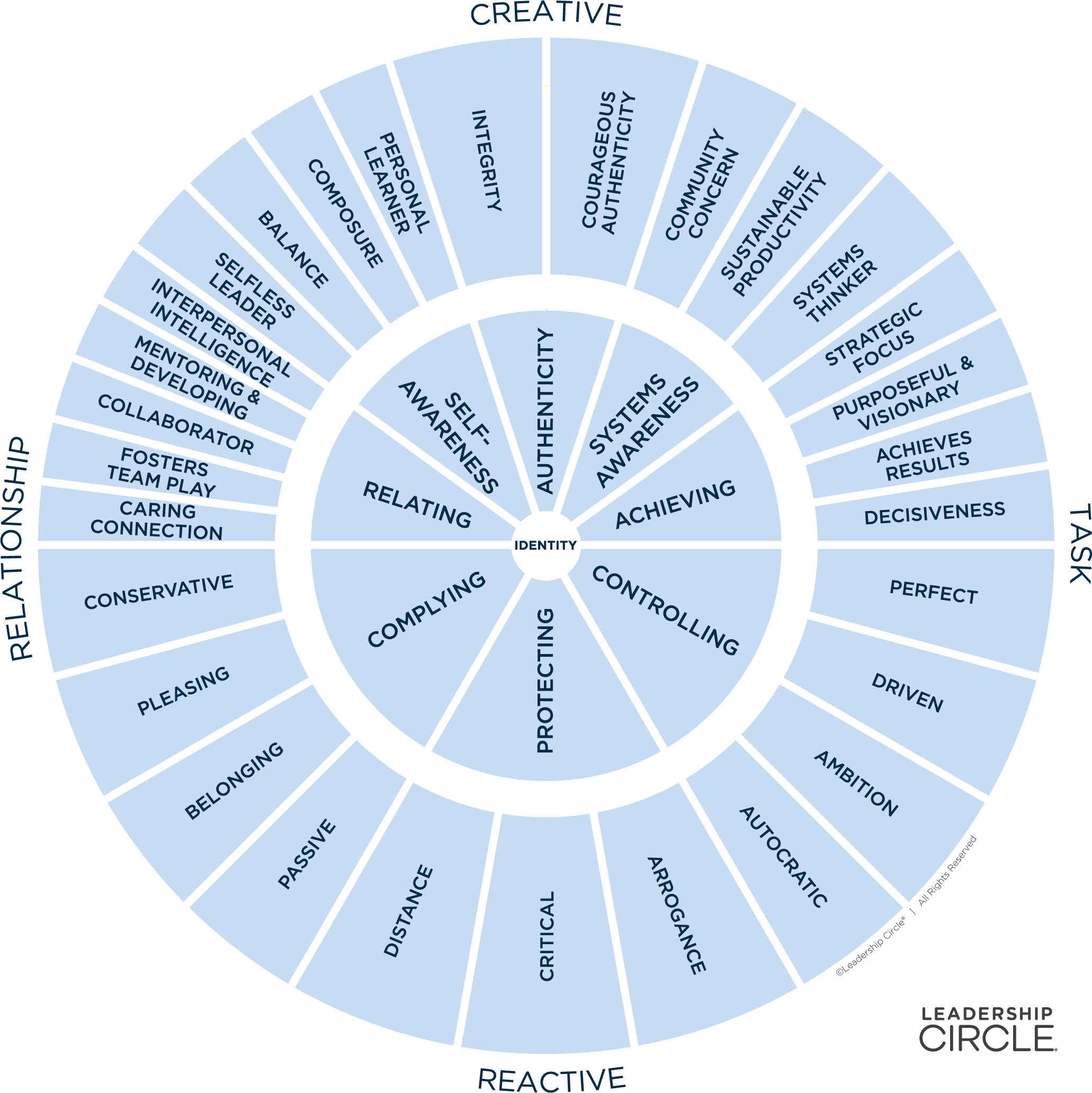
Yes. The goal is a balanced view — highlighting what’s working well and where there are opportunities to grow. Leadership Circle 360 Assessments present these in a unique way. Strengths are shown on the Creative Traits. But they are also shown in the Reactive Tendencies.
The development path asks the leaders to recognize when they are in a protective mode so that they can consciously reach for the Creative expression of their strength instead of the Reactive.
-
The whole assessment process typically takes a few weeks from setup to final report and review session. For the raters, each survey takes about 15 to 20 minutes to complete.
-
No. These 360 leadership assessment tools are intended to catalyze personal growth and increase leadership capacity. They do not measure on-the-job performance.
The LCP evaluates reactive traits which require courage and vulnerability to effectively address. Confidentiality is as important for the leader as anonymity is for the raters.
Leaders are encouraged to discuss their developmental journey with their boss, but it is up to them what details they share.
-
Yes. We offer 360 surveys that identify both individual and group-level patterns. Details are below.
-
It all depends on the assessment you choose and the coaching service that goes with it.
Individual assessments with three-hour debriefs start at $2000. Team assessments start around $3000 for the assessment and a day of team coaching.
Your 360 Coach is happy to discuss that with you in a no-obligation discovery call.
Frequently Asked Questions
What happens next?
After the assessment, you can:
Use the insights on your own to guide your development
Continue with coaching to turn insight into meaningful, sustained change
For leaders and teams looking for deeper impact, the 360 is often the starting point for a longer-term coaching engagement.
Read on to learn more details about each assessment.
Or, give 360 Coaching a call to get a live overview.
The Leadership Circle Profile
Individual Assessment
Most people want to know how they’re doing at work. Are they on the right track, having a positive impact, and continuing to grow? In theory, that’s what performance reviews are meant to provide.
In reality, it’s rare to receive a truly helpful one.
The LCP 360 leadership assessment differs from a performance review in several important ways. The results are private. The leader being assessed maintains full ownership of the feedback.
It’s also a crowdsourcing tool. Your boss may be one of many respondents, but not the only voice. You also receive anonymous feedback from peers and direct reports, giving you a broader and more accurate reflectionof both your strengths and your rough edges.
The LCP puts results in context. You will clearly see how your self-assessment compares to others’ evaluations. You will also see how those numbers compare to a global set of leadership data.
With the support of an experienced coach, you make meaning of the results in confidential sessions and choose your own development goals. 360 Coaching uses this tool in our executive team development program.
-
We begin by collecting feedback from the people who know you well enough to make valid observations. You get to choose who you want on that list. Choose colleagues who are genuinely supportive of your leadership growth. Assure them their answers will be anonymous.
-
The LCP presents complex feedback in a visual way. All of it is confidential. Leadership skills, attitudes, influence, and overall effectiveness are evaluated.
You leave this step with a clear awareness of the traits most shaping your impact, strengths you may be under-leveraging, and personal habits that have outlived their usefulness.
-
Exploring the results in context of your own understanding of yourself, we identify protective habits and belief systems that are no longer serving you. With that, we articulate a desired shift. An updated mindset that will move the needle and produce different results.
-
Insight alone doesn’t change behavior. We craft actionable steps to increase leadership impact. We design experiments, test new responses, try new approaches, refine to make improvements and repeat to integrate these new ways of being.
The Leadership Circle Profile® Stands Apart
The LCP is elegant in the way it highlights your traits and reveals the way you are leveraging them.
For example, you might be highly attuned to nurturing relationships, a strong asset in leadership. At the same time, you might also lean heavy into people-pleasing.
The LCP provides a powerful visual of how how this pattern, over time, can start to work against you to limit clarity, accountability, and results.
It also illustrates how your leadership strengths tend to shift under pressure. Do you get controlling or perfectionistic? Do you retreat and become distant? Do you become overly accommodating?
These patterns are often outside of conscious awareness, yet they strongly shape how others experience your leadership. The LCP brings them into view, along with the ways they may be keeping you stuck.
Context matters, too. The LCP allows you to see how your results compare to a large global norm group, including benchmarks from both the lowest- and highest-performing leaders.
With that perspective, leadership growth is accelerated. You can focus on the growth edge most likely to improve your leadership effectiveness.
Curious if the LCP is the right tool for your people?
Compare the LCP with the other 360 leadership assessments.
There are plenty of assessments out there — MBTI, DISC, Hogan, CliftonStrengths — but most of them stop at surface-level insight.
The Leadership Circle Profile® (LCP), a scientifically validated 360 degree leadership assessment, goes deeper.
It doesn’t just describe behavior or list strengths or give you a comfortable label. It connects behavior to the assumptions and beliefs underneath it. That’s the leverage point for real, sustained leadership development.
-
Strengths
Designed for transformation, not categorization
Focus
Behavior, mindset, and leadership impact
-
Myers-Briggs Type Indicator classifies people into personality types, but lacks depth for growth-oriented leadership work.
Limitation
Fixed types with minimal developmental direction
Focus
Psychological types and preferences
-
DISC - Dominance, Influence, Steadiness, Conscientiousness. This tool profiles behavior styles.
Limitation
Describes surface behaviors; lacks insight into internal drivers
Focus
Behavioral tendencies (D, I, S, C)
-
Hogan Personality Assessments evaluate traits and derailers, but offers limited support for developmental growth.
Limitation
Strong on prediction, limited developmental depth
Focus
Personality traits, derailers, leadership risk
-
Formerly StrengthsFinder, highlights innate talents, yet falls short when leaders need to evolve in complexity.
Limitation
Encouraging but not actionable for deeper leadership growth
Focus
Innate talents across domains

How effective are typical performance reviews?
Spoiler: Not very effective. Traditional performance reviews are meant to support development and improve performance.
In practice, they rarely do either particularly well.
They’re often:
Infrequent
Backward-looking
Shaped by limited perspective
Constrained by evaluation, compensation, or politics
As a result, the feedback tends to be cautious, incomplete, or overly generalized which limits its usefulness for real development.
A 360 degree leadership assessment is designed for a different purpose.
It separates development from evaluation, gathers input from multiple perspectives, and makes patterns visible across relationships and contexts.
That difference matters. That’s why 45% of Fortune 100 companies use the Leadership Circle 360 Profile to strengthen their leaders, rather than relying on performance reviews alone.
With a background in clinical social work and advanced leadership coaching, 360 Coaching brings psychological depth and strategic perspective to the interpretation process — helping leaders see patterns clearly and build new capacity where it matters most.
This isn’t surface-level coaching. It’s development designed to hold up under real-world pressure.
The BRITE Assessment
Broad-based Roots Influencing Team Effectiveness
A BRITE assessment provides precise insights about critical team dynamics. Team members evaluate their own team’s functioning. Team Alignment clients leverage this when their team is low on trust or communication, falling short on deliverables, or moving in opposite directions due to lack of cohesion.
The results provide personalized information on ways to quickly improve and increase the team functioning.
It examines how energy flows through the team across five elements:
Sharing Mindsets. Whether the team's goals, beliefs, and sense of purpose are genuinely shared or just assumed.
Building the Right Structure. Role clarity, accountability, team size, and whether leadership is empowering or draining.
Creating Safety and Cohesion. The trust environment — whether people feel safe enough to be direct, take risks, and show up honestly.
Processing Information. How communication actually flows: where it's open and effective, and where it gets distorted, withheld, or dominated.
Producing Results. The collective capacity to solve problems, make decisions, execute, and hold shared accountability.
Within each element, the assessment determines what's generating energy and what's disrupting it.
The output is a concrete, scored picture of where the team is functioning well and where it's stuck.

-
We leave this 360 feedback survey open for about two weeks.
Each team member should expect to spend about 15 minutes privately answering the questions and assessing their own team dynamics.
-
The BRITE evaluates five critical areas of team dynamics: sharing mindsets, building the right structure, creating safety and cohesion, processing information and producing results.
With the report, your team quickly sees where you have a good flow of energy and where you are blocked.
-
Based on your unique results, your 360 Coach will design team coaching engagements that leverage team strengths to improve team performance in the areas where blocks are obvious.

Collective Leadership Assessment
For team and organizational development
The CLA goes deeper on the dimension of leadership traits as they collectively present in a team or organization. It aligns closely with the LCP leadership framework. Raters can be the team members themselves, or other stakeholders. For example, a board might rate itself or an operations team might rate its executive team.
This tool is a good choice when the organizational focus is both on individual and collective team leadership development. 360 Executive Coaching clients often use this to prepare for strategic growth. If team dynamics are more pressing, start with the BRITE.
The CLA shows both where the team is now and where the raters want it to be in the future from the perspective of leadership traits — the creative competencies teams rely on when they're at their best, and the reactive patterns they fall into under pressure
The raters can be the team members themselves, or other stakeholders. For example, a board might rate itself or it might rate its executive team for their collective effectiveness.
That gap is where the development work lives. The results are most powerful when used to inform individual development alongside collective culture work.
-
The CLA has multiple applications. You will confer with your 360 Coach to determine which collective groups are being assessed and who is assessing them. Break out reports can be useful to compare viewpoints of subgroups. All options are considered before the survey is designed and launched.
-
Much like the LCP, the CLA evaluates various dimensions of leadership. The results are still benchmarked against a large global database of collective leadership effectiveness. Instead of comparing self to evaluator results, the focus now is on current functioning versus desired functioning. The gap between “where we are” and “where we want to be” instantly reveals development opportunities.
-
360 Coaching works closely with the organization to design development work. Groups may opt for executive coaching to give individual focus to the collective effort. Or, they may opt for customized team training sessions, to process and skill-build around dimensions needing the most support.

Your 360 Coaching Roadmap Starts Here
360 leadership assessments give you the starting point. Then you chhoose the journey: executive leadership navigating complexity, teams that aren’t functional, organizations preparing for the future.
A 360 leadership assessment will point clearly to “YOU ARE HERE”.