
Leadership Circle Profile vs. MBTI, DISC, Hogan & CliftonStrengths
Comparing Leadership Assessments
-
Strengths
Designed for transformation, not categorization
Focus
Behavior, mindset, and leadership impact
-
Myers-Briggs Type Indicator classifies people into personality types, but lacks depth for growth-oriented leadership work.
Limitation
Fixed types with minimal developmental direction
Focus
Psychological types and preferences
-
DISC - Dominance, Influence, Steadiness, Conscientiousness. This tool profiles behavior styles.
Limitation
Describes surface behaviors; lacks insight into internal drivers
Focus
Behavioral tendencies (D, I, S, C)
-
Hogan Personality Assessments evaluate traits and derailers, but offers limited support for developmental growth.
Limitation
Strong on prediction, limited developmental depth
Focus
Personality traits, derailers, leadership risk
-
Formerly StrengthsFinder, highlights innate talents, yet falls short when leaders need to evolve in complexity.
Limitation
Encouraging but not actionable for deeper leadership growth
Focus
Innate talents across domains
Compare the LCP with the other leadership assessments.
Clients often ask how the Leadership Circle Profile compares with assessments they've already taken. Most of these are good tools. They just answer different questions.
Here's a basic breakdown.
MBTI (Myers-Briggs Type Indicator)
Self-report
Personality type
Best for team conversations about differences
Doesn’t measure impact on others
The MBTI is probably the assessment you've heard of most often. Isabel Briggs Myers and her mother, Katharine Cook Briggs, built it based on Carl Jung's work on psychological type.
It asks about your preferences in four pairs. Extraversion or Introversion describes where you get your energy. Sensing or Intuition describes how you take in information. Thinking or Feeling describes how you make decisions. And, Judging or Perceiving describes how you organize your life. A person’s “type” ends up being a four-letter acronym. There are 16 possibilities. INTJ, for example, stands for Introversion, Intuition, Thinking and Judging.
It can be useful. A shared vocabulary for differences can ease friction on a team, and many people find their type affirming. I've seen it open good conversations about why one leader wants to talk things through while another needs time alone to think. It gives a neutral way to view how people process, rejuvenate, decipher, and organize.
What it can't do is tell you how you're leading. It's entirely self-report, and a type describes preferences, not effectiveness. Two leaders with the same four letters can have completely different impact on their teams. So, while it is useful for self-understanding, it doesn’t go far with self-awareness.
If you want to know how your leadership lands, you have to ask the people it lands on.
The Myers-Briggs
Extrovert or introvert?
Sensory or intuition?
Thinking or feeling?
Judging or Perceiving?
DISC
Dominance
Influence
Steadiness
Conscientiousness
Self-report
Behavioral style
Good for communication workshops
Doesn’t measure impact on others
DISC grew out of psychologist William Moulton Marston's 1928 model of behavior. Today's versions, like Everything DiSC, describe your style across four dimensions: Dominance, Influence, Steadiness and Conscientiousness.
You answer questions about how you tend to behave, and the profile shows where you land.
It's quick, practical and easy to remember, which is why it shows up so often in team workshops and sales trainings. Knowing that your colleague leans toward Steadiness while you lean toward Dominance can take the sting out of a tense exchange.
The limit is the same as the MBTI's. DISC shows how you see your own behavior, not how it's received. A leader can score as collaborative and still be experienced by their team as controlling. That gap between intention and impact is exactly what senior leaders most need to see.
Self-report
Top talents
Best for building on what you do best
Doesn’t reveal where a strength is overplayed
Gallup's CliftonStrengths, formerly StrengthsFinder, ranks your natural talents across 34 themes, grouped into four domains. Executing, Influencing, Relationship Building and Strategic Thinking. Most people focus on their top five themes.
It's encouraging by design. It gives people language for what they do well, and leaders who know their strengths tend to use them more intentionally. Teams like it because it's positive and easy to share.
What it doesn't show is a strength turned up too high. In my experience, that's where senior leaders get stuck. High standards become control. Decisiveness crowds out input. A gift for harmony turns into avoiding conflict. CliftonStrengths celebrates the strength. It doesn't show you the cost when it's overplayed.
The CliftonStrengths
Executing
Influencing
Relationship Building
Strategic Thinking
Hogan Assessments
Personality Inventory
“Dark Side” Tendencies
Motives, Values, Preferences
Self-report
Traits, Values, Reactive Tendencies
Good for predicting performance and risk
Doesn’t measure impact on others
Hogan is a serious, well-researched set of tools. The Hogan Personality Inventory measures everyday personality, built on the Big Five model. The Hogan Development Survey measures 11 "dark side" tendencies that can derail a leader under stress. The Motives, Values, Preferences Inventory measures what drives you.
Organizations often use Hogan for hiring, high-potential programs and succession planning, because it's designed to predict performance and derailment risk. If you've been through an executive search, there's a good chance you've taken it.
Hogan's core inventories are self-report, and their strength is prediction. They tell you what's likely to happen under pressure. They don't tell you what your colleagues actually experience with you on an ordinary Tuesday. For development work, I want both the pattern and the view of the people around you.
Leadership Circle Profile (LCP)
Multi-rater evaluation
Leadership Impact
Best for leaders ready to change how they lead
Doesn't show personality type or natural talents
This is the one I use, and here's why.
First, the LCP is a true 360. As your coach, I’m working with robust data about your impact across the organization, not just your personal evaluation of your own traits.
We do gather a self-report, but we also gather evaluations from the people who work with you, including your boss, peers and direct reports. You see the two views side by side. All of the data is benchmarked against a global database of hundreds of thousands of leaders so that you can see more than a rating from 1 to 7. You see how you compare in context of the real leaders out there. A “4” in one area may actually be a 99% when compared to others. That’s more informative than the “4”.
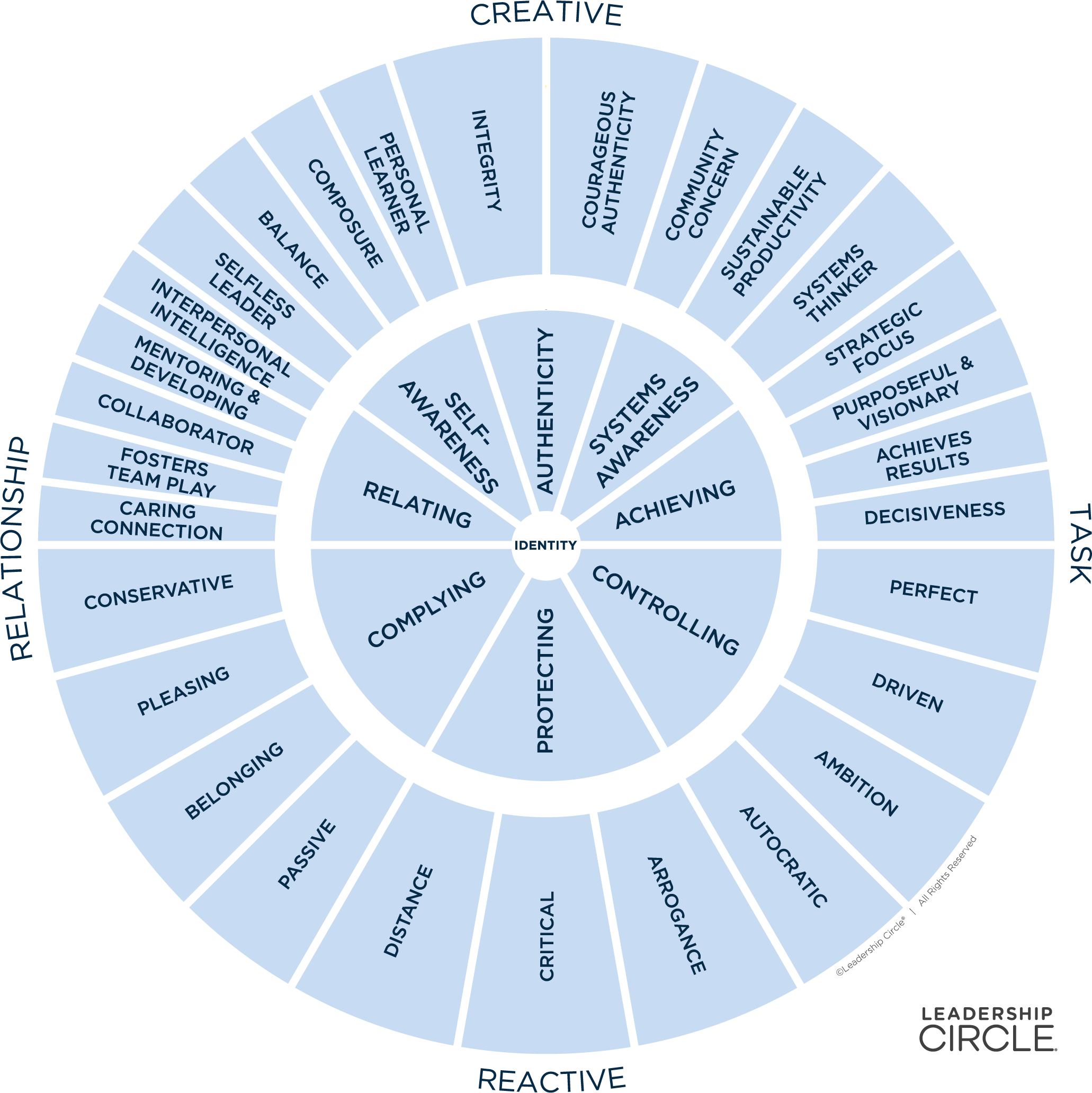
Also, the LCP measures two sides of leadership at once. Creative competencies, like relating to others, self-awareness and systems awareness, are what make leaders effective. Reactive tendencies, like controlling, complying and protecting, are the self-protective habits that show up under pressure. Reactive traits tend to compromise our creative strengths, often in equal measure. Seeing both on one graph shows a leader exactly which habits are getting in the way of their strengths.
Then it goes one level deeper. The wisdom of the LCP guides us in connecting behaviors to the beliefs and assumptions underneath them. That's the leverage point. When a leader sees why they default to control or withdrawal, real change becomes possible.
If you already have MBTI, DISC or CliftonStrengths results, bring them. They add useful context. The LCP shows you what to work on.
Leadership Circle Profile
Creative Strengths
Reactive Tendencies
Leadership Effectiveness
Relationship-Task Balance

The Leadership Circle Profile® Stands Apart
The LCP is elegant in the way it highlights your traits and reveals the way you are leveraging them.
For example, you might be highly attuned to nurturing relationships, a strong asset in leadership. At the same time, you might also lean heavy into people-pleasing.
The LCP provides a powerful visual of how how this pattern, over time, can start to work against you to limit clarity, accountability, and results.
It also illustrates how your leadership strengths tend to shift under pressure. Do you get controlling or perfectionistic? Do you retreat and become distant? Do you become overly accommodating?
These patterns are often outside of conscious awareness, yet they strongly shape how others experience your leadership. The LCP brings them into view, along with the ways they may be keeping you stuck.
Context matters, too. The LCP allows you to see how your results compare to a large global norm group, including benchmarks from both the lowest- and highest-performing leaders.
With that perspective, leadership growth is accelerated. You can focus on the growth edge most likely to improve your leadership effectiveness.
Curious if the LCP is the right tool for your people?

How effective are typical performance reviews?
Most people want to know how they’re doing at work. Are they on the right track, having a positive impact, and continuing to grow? In theory, that’s what performance reviews are meant to provide.
In reality, it’s rare to receive a truly helpful one. Traditional performance reviews are meant to support development and improve performance.
In practice, they rarely do either particularly well.
They’re often:
Infrequent
Backward-looking
Shaped by limited perspective
Constrained by evaluation, compensation, or politics
As a result, the feedback tends to be cautious, incomplete, or overly generalized which limits its usefulness for real development.
A 360 degree leadership assessment is designed for a different purpose.
It separates development from evaluation, gathers input from multiple perspectives, and makes patterns visible across relationships and contexts.
That difference matters. 45% of Fortune 100 companies use the Leadership Circle Profile to strengthen their leaders (Leadership Circle, 2024).
With a background in clinical social work and advanced leadership coaching, 360 Coaching brings psychological depth and strategic perspective to the interpretation process — helping leaders see patterns clearly and build new capacity where it matters most.
This isn’t surface-level coaching. It’s development designed to hold up under real-world pressure.



Your 360 Coaching Roadmap Starts Here
360 leadership assessments give you the starting point.
Then you choose the journey: executive leadership navigating complexity, teams that aren’t functional, organizations preparing for the future.
A 360 leadership assessment will point clearly to “YOU ARE HERE”.
Schedule your no-obligation discovery call.

How it All Connects
Sometimes it’s clear which service suits your needs and sometimes it’s not. Our services can be combined or stand alone. Sometimes one leads to the next:
360 Executive Coaching: project-based; one leader, one-on-one with the coach, includes 360 assessment.
360 Executive Coaching for Senior Teams: project-based; every leader on the senior team, one-on-ones with a single coach, includes individual 360 assessments, and team integration.
Coach & Confidant: ongoing, confidential support for the CEO or founder.
Team Alignment: project-based; when the problem lives inside a team. After collective or BRITE assessment, the team works on how it works together, as a group.
Organizational & Governance Analysis: project-based; when unclear roles, ineffective authority or conflicting decision rights are at play.
If you’re not sure which one is the best fit for you, let’s talk about it. I’m not sales-y so you don’t have to worry about getting a hard pitch.